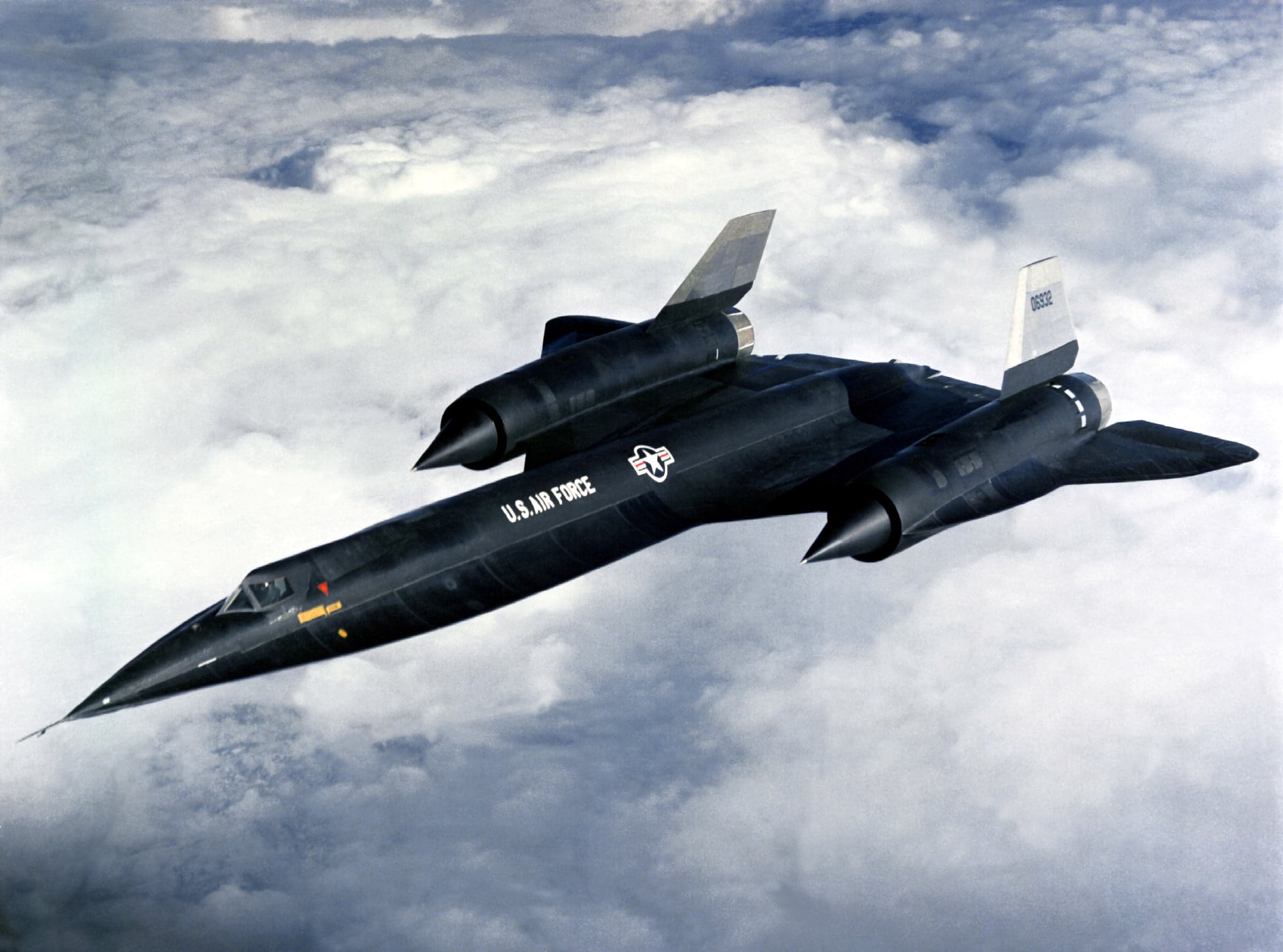
In 1956 the CIA began flying the U-2 over the Soviet Union. Project officers estimated it would be able to do so safely for two years at most. According to the agency’s own history, “the Soviets tracked the U-2 from its first mission.”
A replacement would have to fly faster, higher, and be harder to see on radar. At Lockheed’s Advanced Development Projects division — the Skunk Works — Kelly Johnson’s engineers worked through a series of designs called Archangel-1, Archangel-2 and so on, a carryover from “Angel,” the U-2’s name during development. The names were soon shortened to A-1, A-2. The twelfth was the one the CIA bought.
Convair’s competing design had the smaller radar cross-section. Lockheed’s was cheaper, and Lockheed had delivered the U-2 on time. On 28 August 1959 Johnson wrote in his log that Richard Bissell, who ran the CIA’s reconnaissance programs, had told him “that we had the project and that Convair is out of the picture.” The contract for twelve aircraft was signed on 11 February 1960. Lockheed’s original quotation was $96.6 million. It did not survive.
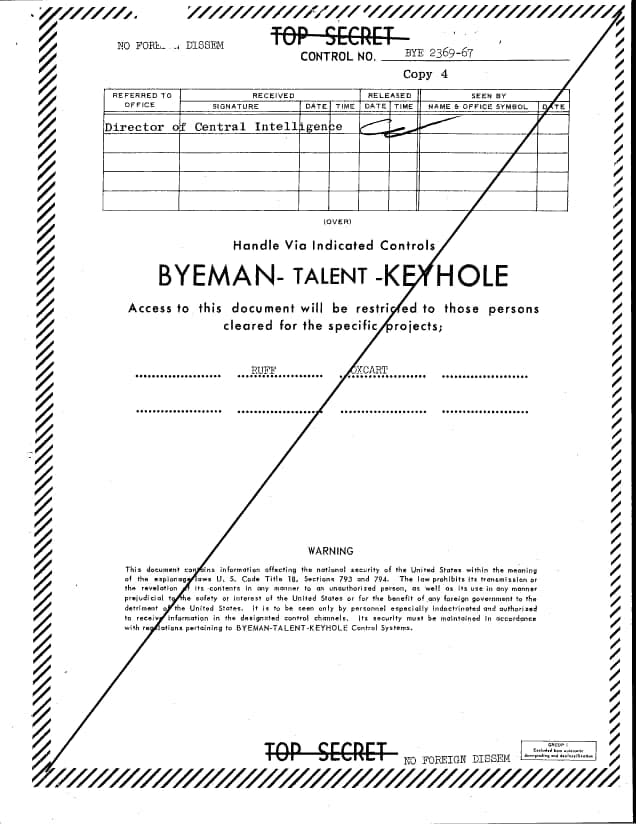
The program needed a name. In the words of a CIA officer writing in 1971, “by a sort of inspired perversity” it came to be called OXCART — a word picked from a random list of codenames, for an aircraft designed to cruise at more than three times the speed of sound.
§ 01A titanium aircraft
At Mach 3 the airframe would heat to between 500 and 600 degrees Fahrenheit, and more near the engines. Aluminum would not survive it. Lockheed built more than 90 percent of the A-12’s airframe from a titanium alloy — nearly as strong as stainless steel at half the weight — and then discovered how little anyone knew about working it.
Early deliveries of the metal were mostly unusable: 80 percent were rejected, by one CIA account; 95 percent, by another. The agency’s later history adds that some of the base metal had to be obtained covertly from the country with the largest known reserves, the Soviet Union.
Titanium also turned out to be sensitive to things that had never mattered before. Pentel pens could not be used to mark it, because the chlorine in their ink etched the metal. Wing panels spot-welded in summer failed within six or seven weeks; panels welded in winter lasted indefinitely. The cause was Burbank’s tap water, which the city chlorinated in summer to keep algae down. The panels were washed in distilled water from then on. When bolt heads began dropping off under heat, the culprit was residue from cadmium-plated wrenches, and hundreds of toolboxes had to be inspected.
The fuel tanks never sealed properly while cold. The A-12 took off with only enough fuel to get airborne, met a KC-135 tanker, filled up, and climbed straight to altitude, where the metal expanded and the leaks closed. The fuel itself, JP-7, had a flash point so high that, in the CIA history’s words, “a lighted match would not ignite it.” The engines were lit with a liquid chemical that exploded on contact with air.
Each of the two Pratt & Whitney J58 engines produced, by the CIA’s comparison, as much power as all four of the Queen Mary’s turbines. To start one, ground crews used a cart carrying two Buick racing engines — later Chevrolets — producing more than 600 horsepower between them.
§ 02The test site
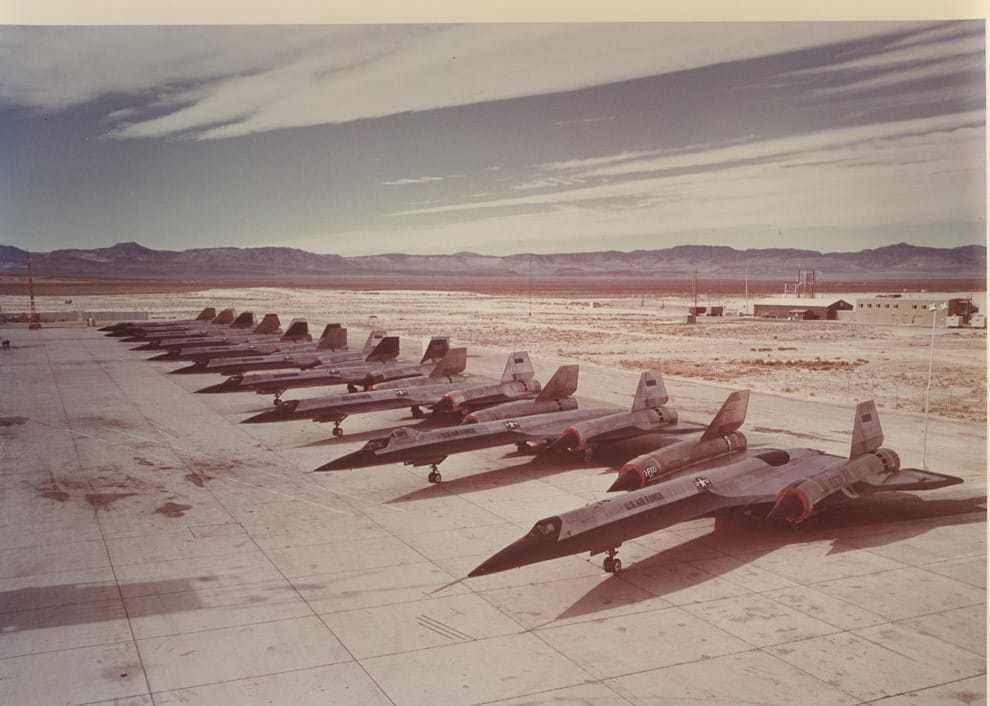
The aircraft were tested at a remote site in Nevada, at Groom Lake, which the CIA did not officially acknowledge until 2013. Nevada law required the names of contractor personnel staying in the state for more than 48 hours to be reported to the authorities; government employees were exempt. So, the CIA’s historian recorded, “all contractor personnel going to the site received appointments as Government consultants, and if questions were asked the reply could be that no one but government employees were at the site.”
The airframes travelled from Burbank by road, in sections, in crates 35 feet wide. During one delivery a Greyhound bus coming the other way grazed a crate. Project managers authorized nearly $5,000 for the damage to the bus, so that no insurance or legal inquiry would take place.
The first flights, in late April 1962, did not go quite to plan. On the first attempt Lockheed test pilot Lou Schalk lifted off briefly and set the aircraft down on the lakebed beyond the runway; Johnson’s voice came over the radio: “What in Hell, Lou?” On the next, the A-12 shed several of its titanium “pie slice” fillets shortly after takeoff, and technicians spent four days finding and reattaching them. The official first flight was recorded on 30 April 1962. CIA sources do not agree on which of these to count.
§ 03Cover stories
On 24 May 1963 CIA pilot Ken Collins ejected from Article 123 near Wendover, Utah, after iced instruments sent the aircraft into a stall. Witnesses signed secrecy agreements. Collins agreed to take truth serum to help the investigation recall what had happened. The press was told the aircraft was an F-105.
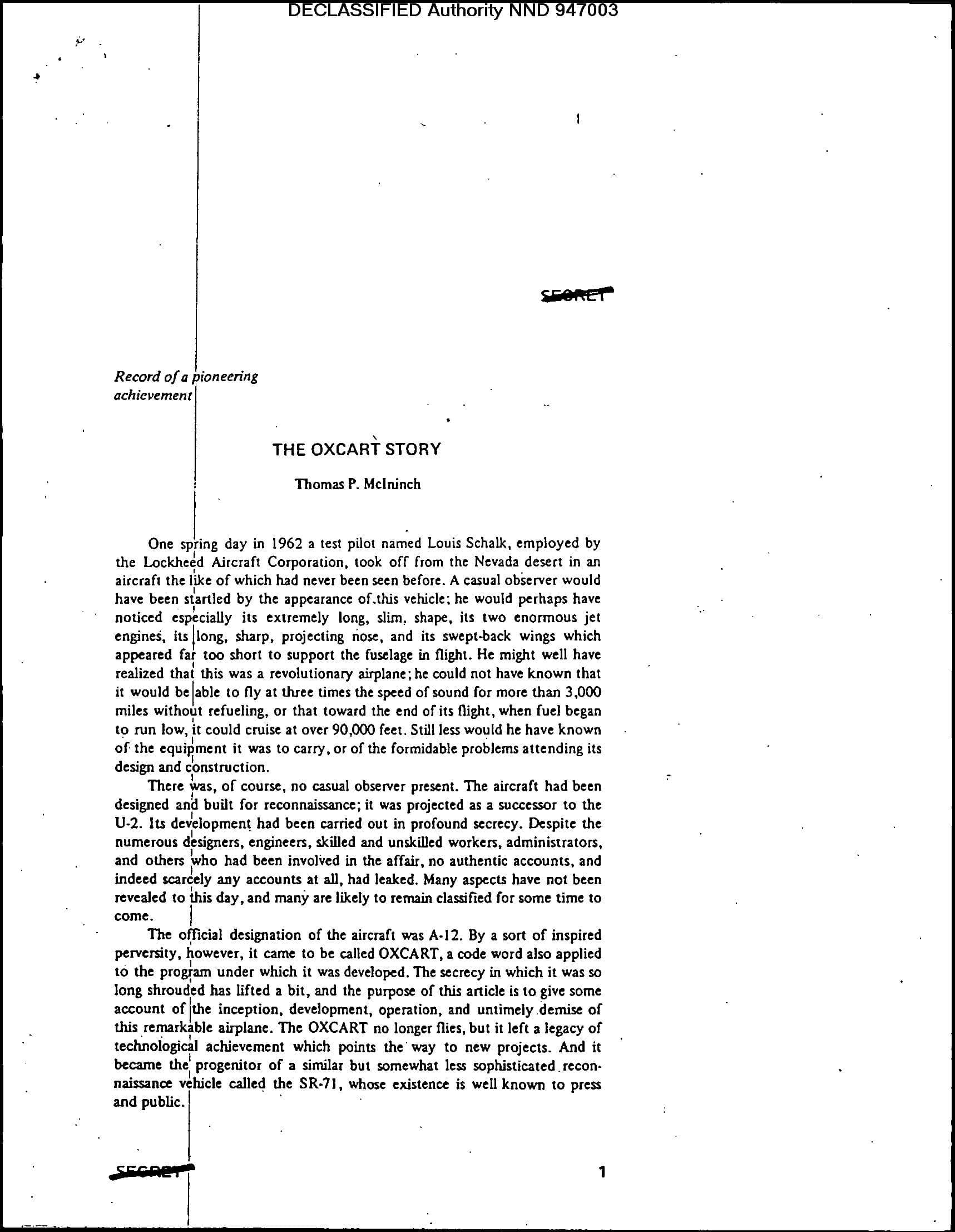
A cover story for the press described the accident as occurring to a F-105, and it is still listed in this way on official records.
- Origin
- Thomas P. McIninch, Studies in Intelligence 15:1 (CIA). Approved for release 1994
- Date
- 1971
- Ref.
- PDF p. 16
The following February, with rumors spreading, President Johnson decided to surface the aircraft — or rather, a version of it. On 29 February 1964 he told reporters: “Several A-11 aircraft are now being flight tested at Edwards Air Force Base in California.” None were. The A-11 was the Air Force’s YF-12A interceptor, a derivative of the A-12, and two had to be flown to Edwards in a hurry to support the statement. Kelly Johnson recalled that they were still so hot that the hangar’s fire-extinguishing system came on, which “gave us a free wash job.”
In July 1964 the President announced another derivative, the Air Force’s two-seat RS-71. He transposed the letters. Air Force officials, according to the CIA history, let the error stand and created a “strategic reconnaissance” category to fit it. The SR-71 first flew on 22 December 1964.
§ 04Black Shield
The A-12 was declared operationally ready in November 1965 and did not fly an operational mission for another eighteen months. In May 1967 it deployed to Kadena Air Base, Okinawa, under the name BLACK SHIELD. On 31 May, Mele Vojvodich took off in Article 131 in a torrential downpour — the A-12 had never operated in heavy rain — on a flight of three hours and 39 minutes, at Mach 3.1 and 80,000 feet, over North Vietnam. The cameras photographed 70 of the 190 known surface-to-air missile sites.
The aircraft were painted black and carried no markings other than red tail numbers, which were changed every mission. A typical pass over North Vietnam took about twelve and a half minutes. On 30 October 1967 at least six missiles were fired at Dennis Sullivan’s aircraft; afterwards a small piece of metal was found lodged against the support structure of a wing tank. When a route over North Korea was proposed after the seizure of the USS Pueblo in January 1968, Secretary of State Dean Rusk suggested changes to the flight plan, “thus becoming the project’s highest ranking flight planner.”
§ 05The derivative
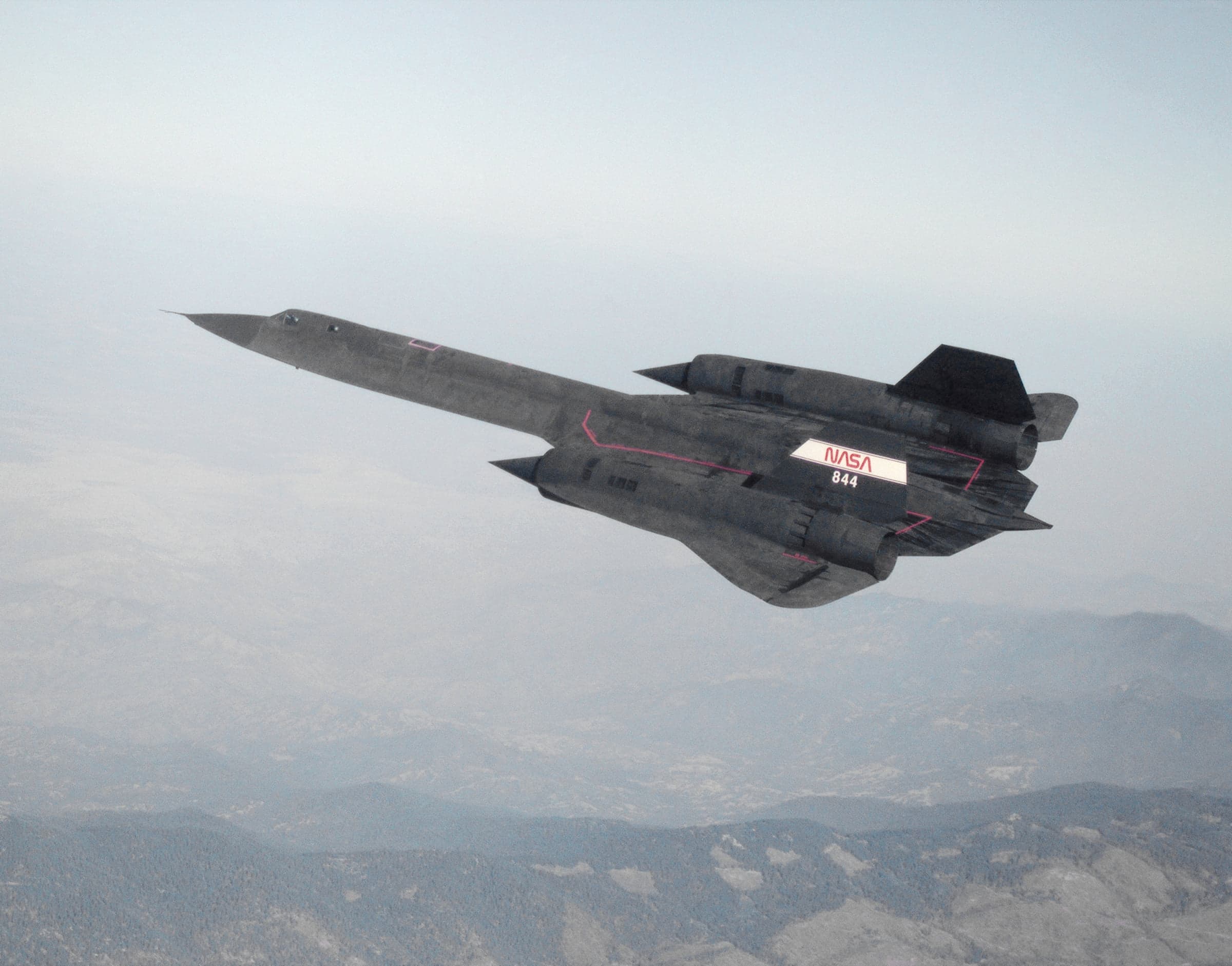
The SR-71 was the A-12, reworked for the Air Force. According to the CIA, it was about six feet longer, weighed 15,000 pounds more fully loaded, had more prominent chines, a second seat for a reconnaissance systems officer, and interchangeable noses for different sensors. It flew slower and lower than the A-12 but further. The A-12’s camera had the wider swath and the better resolution.
Two fleets of nearly identical aircraft, run by two organizations, was an arrangement the Bureau of the Budget began questioning in November 1965. On 28 December 1966 President Johnson directed that the OXCART program be terminated. A fly-off between the two types in late 1967, codenamed NICE GIRL, was inconclusive. The A-12’s last operational mission was flown in May 1968.
When Walt Ray died in an A-12 crash in January 1967, the Air Force told the media that an SR-71 was missing and identified the pilot as a civilian. When Jack Weeks and Article 129 disappeared east of the Philippines on 4 June 1968, during the drawdown, the official news release again identified the aircraft as an SR-71. For most of its life the A-12 was reported, when it was reported at all, as the aircraft that replaced it.
On 26 June 1968 the operational pilots received the CIA’s Intelligence Star; Weeks’s was awarded posthumously. Their wives attended the ceremony, where, in the CIA history’s words, they “learned for the first time what their husbands really had been doing for the past several years.” The surviving aircraft were flown to Palmdale, California, and put in storage.
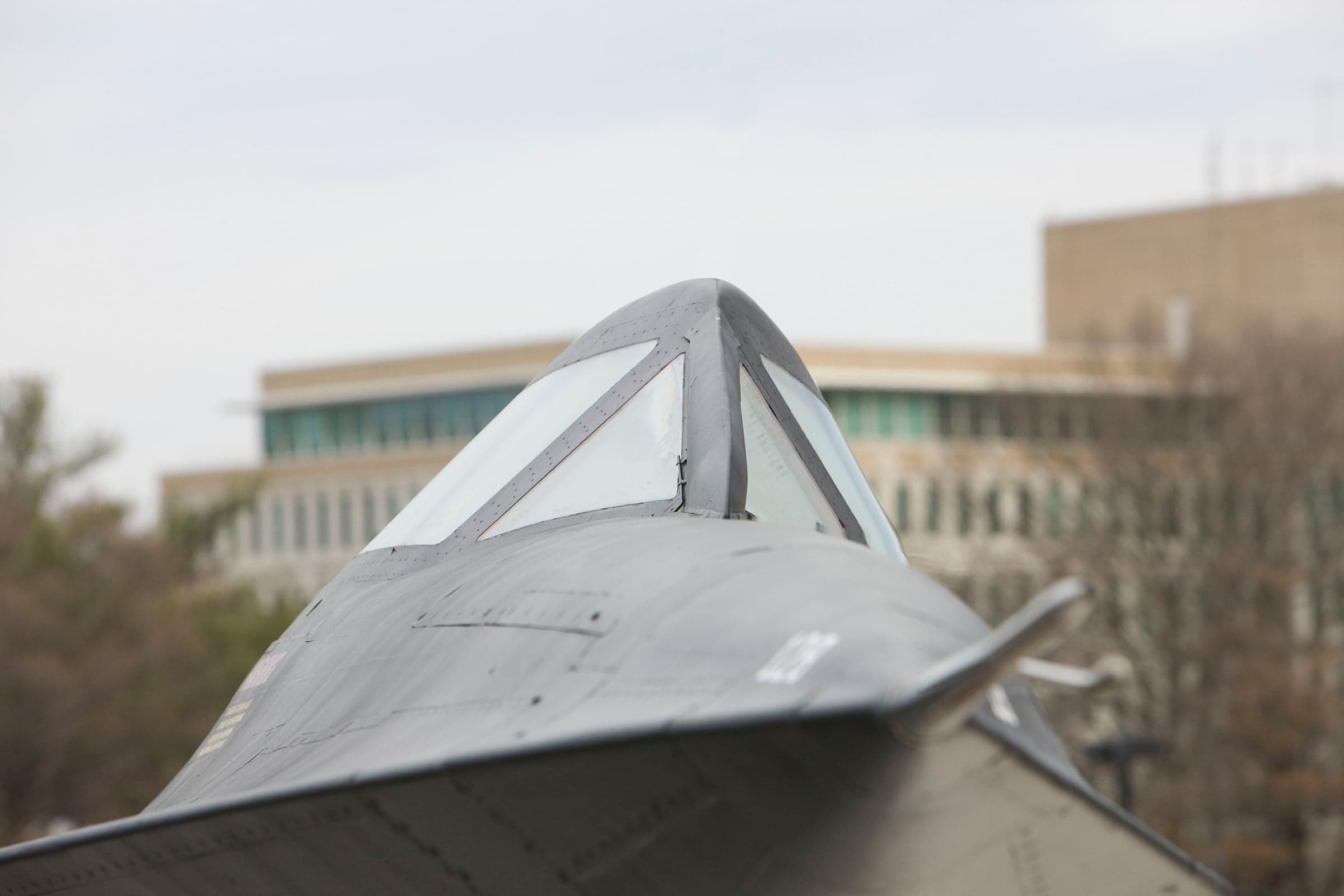
Article 128 now stands on pylons at CIA headquarters in Langley, Virginia, on loan from the Air Force. Its tail number is no longer changed every mission.